Rennteam Uni Stuttgart · Formula Student Electric & Driverless · season 2023/24
Live data from a race car to the pit wall
Low-voltage electrics and telemetry for a Formula Student race car.
For the 2023/24 season I was responsible for the car’s low-voltage electrics and telemetry. Most of the hardware and software came from earlier team members; my job was to learn the system end to end, keep it running on the car and plan the next improvements.
My contribution
Responsible for low-voltage electrics and telemetry.
I learned an inherited system end to end, kept it running on the car and investigated where it failed.
Gateway firmware
Set up the STM32 toolchain (CLion, CMake, arm-none-eabi-gcc) and studied the gateway firmware: CAN interrupts, CAN-to-UDP conversion, the lwIP network stack and time sync.
Fault diagnosis
Diagnosed CAN and Ethernet faults with Vector CANoe/CANalyzer, CANape, PCAN and Wireshark, and debugged with ST-Link in STM32CubeIDE.
Overheating switch
Investigated communication drops from an overheating Ethernet switch board: converted the KiCad design, marked the power rails for measurement and proposed better cooling or a commercial switch.
Vehicle data
Defined a CAN node in the team’s vehicle node description (YAML to DBC and C headers), converted logs to MF4/MAT for analysis and co-authored the season’s telemetry pre-design.
Wiring harness
Wiring-harness work, including crimping connectors.
How the data travels
From three CAN buses to the pit wall.
The gateway turns traffic from three CAN buses into live data for the pit wall.
CAN buses
Sensor nodes send CAN frames on three vehicle buses (body, sensor and battery).
Gateway
An STM32F765 board timestamps each frame with 1 µs resolution and bundles frames into one UDP packet every 10 ms or every 64 frames.
Data logger
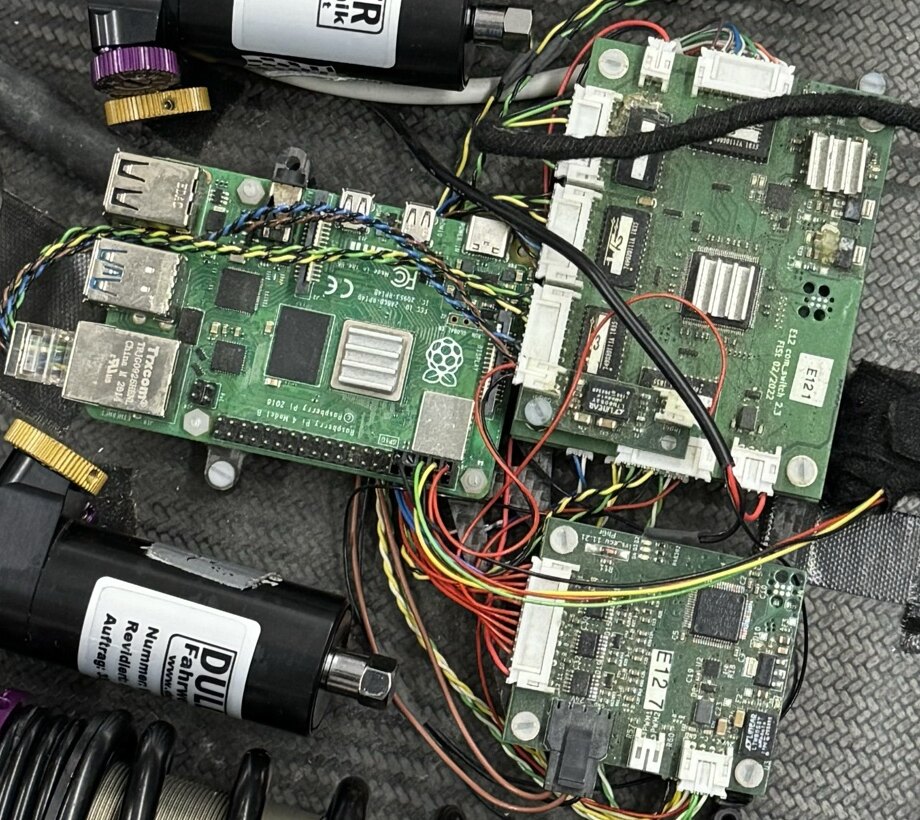
Over car Ethernet, the packets reach a Raspberry Pi that records every frame and forwards data over LTE.
Track server
Over WiFi, the same packets reach the track server, which stores them and serves live dashboards in Grafana and Vector CANape. CAN messages can also be sent back to the car.
Scale and context
A full-size vehicle network, raced in 2024.
These numbers describe the whole car’s system, not my part alone.
≈ 60
ECUs and sensor nodes
In the car’s database.
455
CAN messages
In the car’s database.
2
events in 2024
Formula Student Austria and Formula Student Germany.
Reflection
What I would improve.
The open issue I investigated was the Ethernet switch board.
Known issue
An overheating Ethernet switch board caused communication drops.
What I would improve
Better cooling for the Ethernet switch or a commercial replacement, and a validated voice-radio setup for the driver.