ReDance · Project lab Human-Centered Neuroengineering: Neurorehabilitation · TUM · Summer 2026 · team of 5
A dance game that helps a stroke patient move
A seated, music-driven rehabilitation game designed around one patient.
A 74-year-old stroke patient with one-sided weakness loves music and dancing but is afraid of falling. Her balance assessment (Berg Balance Scale) showed deficits in trunk flexion, trunk rotation and hip flexion. The exercises had to be safe while seated, motivating without being exhausting, and in simple German.
My contribution
Data path and game logic, in a team of five.
I turned raw IMU data into live movement detection and built the game around it.
Sensor analysis
IMU data logger with live plots, and the analysis that decided which sensor measures which movement.
Live detection
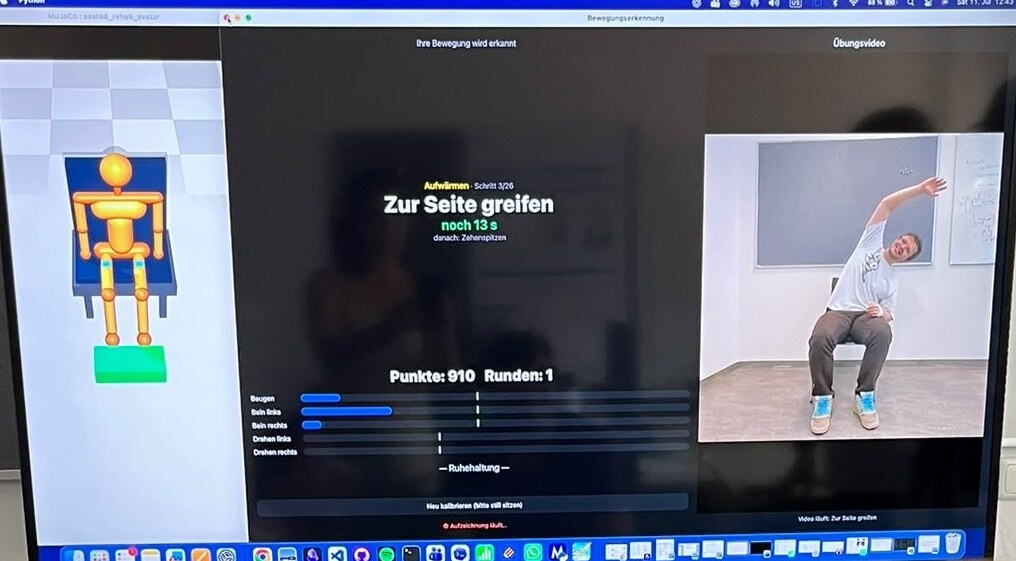
Live movement detection, including turn sensing from the integrated gyro on the upper back, the part that needed the most iterations.
Game and logging
The MuJoCo live mode, calibration breaks with real recalibration, no-punishment game logic, session logging, music and video sync, and the German simple-language UI.
Robustness
On the PC side: handling empty frames from cable or multiplexer outages and waiting for the serial port.
How it works
Four sensors, one calibration, transparent rules.
Every decision the game makes can be explained to a therapist.
Sense
Four ICM-20948 IMUs (lower back, upper back, both thighs) on an ESP32 stream to a Python app over USB serial.
Calibrate
Works for any sensor mounting: a median gravity baseline per sensor and the patient’s own movement directions.
Classify
A transparent rule-based classifier for 5 movements plus neutral, so therapists can explain every decision.
Play and log
A 39-step routine with instruction videos, spoken German rewards, music, a score and a live MuJoCo avatar. Every session is logged for physiotherapist review.
Results, with context
Playable live, with clear next fixes.
All results come from a small evaluation; the notes say what each number covers.
≈ 30 Hz
median live sampling
33 ms between samples. The limit is the 115,200-baud text-based serial link, not the sensors.
637 / 637
detected samples labelled correctly
10 labelled seated recordings from one team member, in-sample. Right turns were never detected offline.
67.5
System Usability Scale
Perceived usability from 0 to 100; 68 is the usual average.
The workload questionnaire showed no time pressure but high effort and frustration, which pointed to straps and recalibration as the next fix.
Reflection
Turn detection is still the weakest part.
The game works live, but the evaluation is still small.
Known limits
One subject, in-sample evaluation and no end-to-end latency measurement.
Next steps
More subjects, a magnetometer-based heading estimate and a replay view for physiotherapists.
TeamSimon Appoltshauser, Emily Joyce, Eraraya Morenzo Muten, Maysa Ouaja and Yujie Yang.